Custom software is not a product you buy off a shelf. It is a capability you commission, and the price depends on what you are building, how complex it is, and how clearly you can describe it. This guide breaks down what custom software actually costs in Kenya in 2026, what drives those costs, and how to budget without getting burned.
What counts as custom software
Custom software means anything built specifically for your business rather than adapted from an existing product. That includes web applications, mobile apps, marketplaces, dashboards, internal tools, API integrations, and automation systems. A WordPress site with a plugin is not custom software. A bespoke booking system with M-Pesa reconciliation, role-based access, and reporting is.
Price ranges by project type
These are realistic Kenya 2026 ranges for a professional team, not a freelancer with a template.
- Simple web application (CRUD app, internal tool, single user role): KES 500,000 - 1,200,000.
- Multi-role web platform (marketplace, SaaS, dashboard with analytics): KES 1,200,000 - 3,500,000.
- E-commerce build (custom cart, M-Pesa, inventory, admin): KES 300,000 - 2,000,000.
- Mobile app (single platform): KES 800,000 - 2,500,000.
- Cross-platform mobile app (iOS + Android): KES 1,500,000 - 4,000,000.
- API integration layer (connecting existing systems): KES 200,000 - 800,000.
What drives cost
Five factors determine where your project lands in those ranges. One: number of user roles and permissions. A system with admin, manager, and customer roles costs more than one with a single login. Two: integrations. M-Pesa STK Push, SMS gateways, email services, and third-party APIs each add complexity and testing time. Three: data. Migrating from spreadsheets or legacy systems, cleaning dirty data, and building import tools takes real effort. Four: real-time features. Live dashboards, chat, notifications, and WebSocket connections add architecture cost. Five: compliance. Data protection, audit trails, and regulatory requirements add scope.
The M-Pesa factor
If your software takes payments, M-Pesa integration is not optional in Kenya. Safaricom Daraja API provides STK Push (customer pays from phone), B2B (business to business), and C2B (customer to business) flows. Each requires sandbox testing, callback handling, idempotency, reconciliation, and error messaging. Budget KES 100,000 - 300,000 for a clean M-Pesa integration with proper error handling and a reconciliation dashboard. A developer who says "we will add M-Pesa later" has never built it.
Timeline expectations
Realistic timelines for a professional team with a clear brief: simple web app 6-10 weeks, multi-role platform 3-6 months, mobile app 8-16 weeks, e-commerce build 4-8 weeks. Timelines slip when scope changes mid-build, when content is not ready, or when the client takes two weeks to review each deliverable. Build buffer into your plan.
How to budget without getting burned
Start with the outcome, not the feature list. "We need a system that lets 50 field agents submit daily reports with photos and get manager approval within 24 hours" is a budgetable brief. "We need a mobile app with all the features" is not. Write the brief, get three quotes in the same format (scope, breakdown, timeline, support), and compare them on scope coverage, not price. The cheapest quote is usually missing something.
Scope creep: the silent budget killer
Scope creep happens when features are added mid-build without adjusting timeline or budget. A client says "can we also add WhatsApp notifications?" and the developer says "sure, no problem" without pricing it. Three months later, the budget has doubled and nobody knows why. Prevent it by defining MVP scope in writing, requiring written change requests with cost estimates, and using milestone payments tied to deliverables.
Build vs buy
Before commissioning custom software, check if an existing tool solves 80% of your problem. Accounting software, CRM systems, project management tools, and email platforms are mature and cheap. Build custom only when your workflow is your competitive advantage, when no existing tool fits, or when you need full ownership of the technology. Building a custom accounting system when QuickBooks exists is a waste of money.
What to ask before signing
Ask every candidate: who exactly will work on the project (names and roles), can you speak to a client with a similar project, what does the first two weeks look like, how is content and data handled, what is the defect window, who owns the code and accounts, and what does support cost after launch. Vague answers to any of these are warning signs.
Where to go next
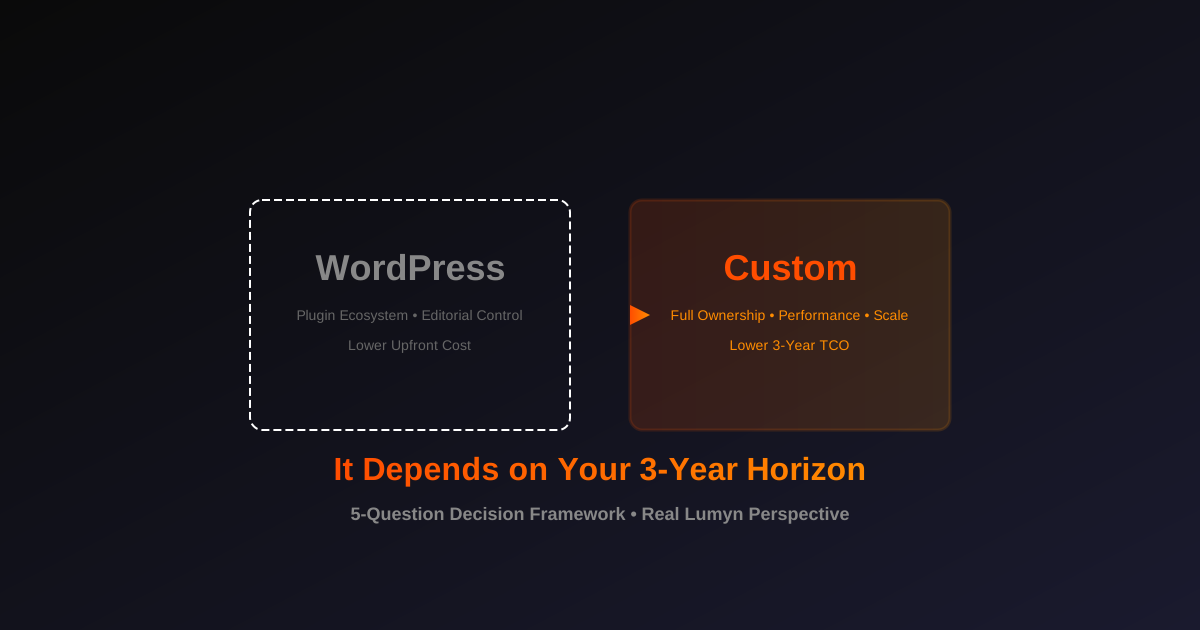
If you are deciding between WordPress and custom, our guide to custom website vs WordPress covers the trade-offs. If you need to choose a development partner, how to choose a web development company in Kenya walks through the evaluation process. And what a website costs in Kenya breaks down the pricing tiers for simpler projects.
Build what comes next
Want to explore what these ideas could mean for your business? Start a conversation with our team.