M-Pesa is not just a payment method in Kenya. It is the financial infrastructure that makes e-commerce possible for millions of people who do not have credit cards or bank accounts. When a customer in Kisumu buys shoes from a Nairobi seller, M-Pesa is the bridge. Understanding how M-Pesa shapes e-commerce — from checkout to trust to reconciliation — is essential for anyone building or selling online in Kenya.
The scale of M-Pesa in Kenya
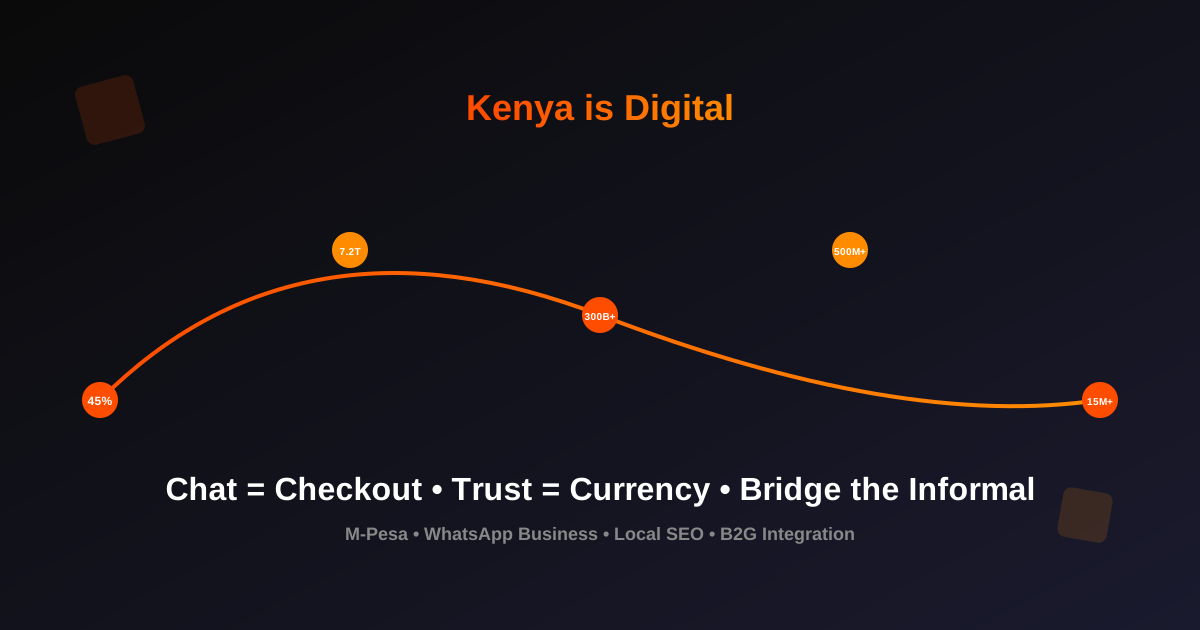
Safaricom reports over 30 million M-Pesa users in Kenya. That is more than half the population. For e-commerce, this means your addressable market is not "people with cards" — it is "people with phones." A checkout that requires a Visa card excludes the majority of Kenyan buyers. A checkout that accepts M-Pesa reaches them.
How M-Pesa changes the checkout flow
A traditional e-commerce checkout asks for card number, expiry, CVV, and billing address. An M-Pesa checkout asks for a phone number and sends an STK Push prompt to the customer phone. The customer enters their PIN, and the payment completes in seconds. No card details, no 3D Secure redirects, no abandoned carts from complex forms. The friction is lower, and the conversion rate is higher — for Kenyan customers.
Trust and the M-Pesa advantage
Kenyan consumers are wary of paying for goods they have not seen. M-Pesa reduces that risk because the payment is reversible-ish (via customer care) and the merchant is identifiable by their Paybill or till number. A seller with a registered Paybill is more trustworthy than one asking for a personal M-Pesa number. The payment rail itself carries trust signals that a card checkout cannot replicate.
Paybill vs Buy Goods for e-commerce
Paybill numbers are registered to a business and deposit funds directly into a bank account. Buy Goods till numbers are for retail point-of-sale. For e-commerce, Paybill is usually better: it offers cleaner reconciliation, direct bank settlement, and a professional appearance. Buy Goods works for simple, low-volume sellers. High-volume merchants should use Paybill with automated reconciliation via the Daraja API.
The reconciliation challenge
Every M-Pesa payment generates a callback with the transaction ID, amount, phone number, and account reference. Matching these callbacks to orders is the hardest part of M-Pesa e-commerce. Customers enter wrong account references. Callbacks arrive out of order. Network failures cause missed callbacks. A robust e-commerce system uses idempotency keys, retry logic, and a reconciliation dashboard that flags mismatches within minutes. We covered the exact pattern in what three M-Pesa integrations taught us.
Cash on delivery vs M-Pesa
Cash on delivery is still common in Kenyan e-commerce, especially for physical goods. It works because it eliminates buyer risk. But it is expensive: delivery riders carry cash, failed deliveries waste trips, and reconciliation is manual. M-Pesa reduces these costs but requires the buyer to trust the seller enough to pay before delivery. The best e-commerce platforms offer both and let the customer choose.
What M-Pesa means for small businesses
A Kenyan SME can start selling online with nothing more than an M-Pesa Paybill and a WhatsApp number. No payment gateway, no merchant account, no monthly fees. As volume grows, they upgrade to automated checkout, reconciliation dashboards, and inventory management. M-Pesa lowers the barrier to entry for e-commerce in a way that card-based systems never could.
The future: M-Pesa and beyond
M-Pesa is evolving. Safaricom is expanding into merchant services, credit (Fuliza), and international remittances. For e-commerce, the trend is toward deeper integration: one-click M-Pesa checkout, automated refunds, subscription payments, and cross-border M-Pesa. Businesses that build on M-Pesa today are building on the rails that will carry Kenyan e-commerce for the next decade.
Where to go next
If you are building an e-commerce site, our guide to what a website costs in Kenya covers pricing, and how to choose a web development company helps you find a team that understands M-Pesa integration. For the technical details, what three M-Pesa integrations taught us breaks down the implementation.
Build what comes next
Want to explore what these ideas could mean for your business? Start a conversation with our team.