Most advice about SEO is written for marketers, not for the business owner who needs customers next month. This guide is written for the latter. If you run a business in Kenya and you want to understand what SEO is, why it matters, and what to actually do first, this is it.
What SEO actually means
SEO stands for Search Engine Optimization. It is the practice of making your website visible in Google when people search for what you offer — without paying for every click. When a customer in Nairobi searches "plumber in Westlands" or "best flour mill in Kenya," SEO is what decides whether your business appears on the first page or disappears onto page four, where almost nobody looks.
Why SEO matters for Kenyan businesses
Kenya's internet penetration is among the highest in Africa, and mobile search dominates. Your customers are already searching for what you sell — on their phones, in the moment they need it. A competitor who shows up in those searches gets the enquiry. You get nothing. Unlike a social media post that vanishes in a day, a well-ranked page keeps working for years. SEO is the only marketing channel that compounds: every month of good work builds on the last.
The three kinds of SEO
SEO splits into three areas. On-page SEO is the content itself: clear titles, useful writing, and the words your customers actually search for. Technical SEO is the plumbing: fast loading, mobile-friendly, and a site Google can crawl without getting lost. Local SEO is being findable for "near me" searches — your Google Business Profile, your address, and your reviews. A business in Kenya needs all three, but local SEO is often the fastest win for a single-location business.
How Google decides what to show you
Google wants to answer the searcher's question as fast and accurately as possible. It ranks pages that are relevant to the query, authoritative on the topic, and useful to the person searching. Authority comes largely from other websites linking to you — each link is a vote of confidence. This is why a directory listing, a supplier partnership, or a mention in a local news piece matters: they are links, and links are trust.
What to do first
Start with three things. One: claim your Google Business Profile — it is free, it controls your local visibility, and it takes twenty minutes. Two: make sure your site loads fast on a phone, because most Kenyan users will never see the desktop version. Three: write one genuinely useful page for the service you offer, using the words a customer would type. Not ten pages. One good page beats ten thin ones.
How to pick keywords
A keyword is the phrase someone types into Google. Pick keywords by thinking like your customer, not like your industry. A customer does not search "B2B procurement solutions" — they search "where to buy wholesale maize in Nairobi." Write down the ten phrases your customers actually say out loud, then check them in Google. If the results are mostly your competitors, that is a keyword worth targeting. If the results are Wikipedia and the BBC, a small site will not rank for it yet — start narrower.
Local SEO: the fastest win
For a business serving a specific area, local search is where the money is. Claim and complete your Google Business Profile with accurate hours, a phone number that answers, photos, and your service areas. Ask every satisfied customer for a review — the number and quality of reviews directly affect local ranking. Keep your name, address and phone number identical everywhere they appear online, because inconsistencies confuse both Google and customers.
Common mistakes that cost Kenyan businesses traffic
The biggest mistake is a website that is beautiful but says nothing about what the business actually does. Google cannot rank a page that does not clearly answer a question. The second is ignoring mobile — a slow or broken mobile site loses the majority of Kenyan searchers before they read a word. The third is keyword stuffing, the old trick of repeating a phrase until the text reads like a robot wrote it. Google penalizes that now. Write for humans; the ranking follows.
How long does SEO take?
Be suspicious of anyone who promises first-page rankings in a month. Realistic timelines: local SEO results in two to six weeks once your profile is complete; organic traffic in three to six months for a new site; competitive national keywords in six to twelve. SEO is a long game, but it is the only game where the lead keeps arriving while you sleep.
What to measure
Ignore vanity metrics like "we are number one for a keyword nobody searches." Watch three things: how many people find you in search (Google Search Console, free), how many of those visitors contact you, and which pages bring the enquiries. If a page brings traffic but no enquiries, the page is attracting the wrong audience — fix the page, not the traffic.
Where to go next
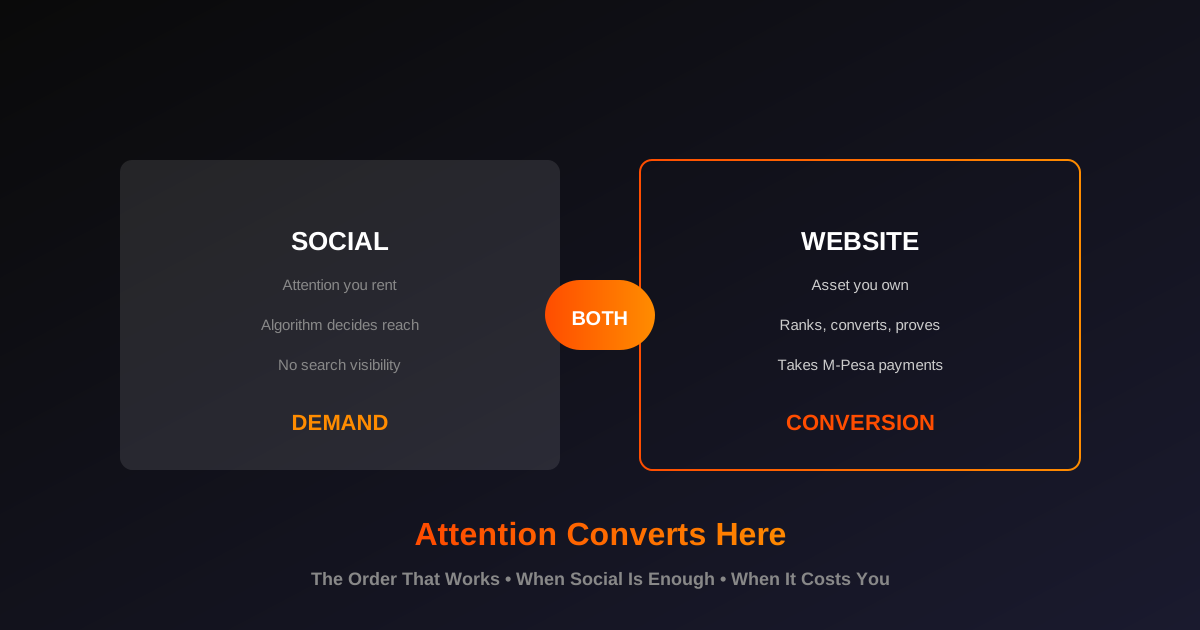
Once the basics are in place, the next step is understanding where search is heading. Our guide to how AI is transforming SEO explains the shift to semantic search, and why every Kenyan business needs a professional website covers the foundation all of this sits on. If you are weighing search against social, website vs social media lays out the trade-off.
If you would rather have someone do this for you, talk to the Lumyn team. We build websites that are search-ready from day one, and we will tell you honestly if SEO is not the right move for your business right now.
Build what comes next
Want to explore what these ideas could mean for your business? Start a conversation with our team.